Gas Prices

  • Subscribe to our RSS feed.
  • Twitter
  • StumbleUpon
  • Reddit
  • Facebook
  • Digg

Monday, 30 September 2013

ECRI recession call: unhappy two year anniversary

Posted on 06:30 by Unknown

- by New Deal democrat

Today exactly two full years have passed since Lakshman Achuthan of ECRI appeared on all of the cable business channels and announced that the US was "tipping into recession." Here he is on WSJ:


At the 30 second mark, one of the hosts asks, "When?" and Achuthan responds "Now."

At the 50 second mark, he gets more specific: "It might have started last month. It might start next month. But sometime I think it's going to wind up in the 3rd or 4th quarter" -- of 2011!

Subsequently Achuthan repeated his call, revising the timing to Q4 of 2011 through Q2 of 2012. Although Bloomberg no longer has the video on its site, here is a link to a copy in which Achuthan specifically says, at the 1:20 mark, "If there's no recession in Q4 or in the first half I'd say of 2012, then we're wrong. You're not going to know whether or not we're wrong until a year from now." That would have been 9 months ago, in December 2012.

Subsequently ECRI revised its call again, saying that a recession started in July 2012. In December of last year, to justify this latest call, ECRI premiered what they called their tell-tale chart, opining:
Reviewing the indicators used to officially decide U.S. recession dates, it looks like the recession began around July 2012. This is because, in retrospect, three of those four coincident indicators – the broad measures of production, income, employment and sales – saw their high points in July (vertical red line in chart), with only employment still rising.
Here's the chart:


That chart too has vanished down the memory hole, but here's what it looks like updated through August 2013:

Photobucket Pictures, Images and Photos

Since that time, ECRI has reeled like a punch-drunk boxer from data series to data series to data series, latching on to whichever one has in the past been consistent with a recession. Last week Achuthan was reduced to tweeting about how industrial production stayed positive for 5 months into the 1974 recession (which is one-third of the amount of time that has passed since July 2012. And don't mention to him that payrolls have never risen this far or this long since the onset of a recession). The simple fact is, barring massive downward revisions of all sorts of economic data, ECRI's call was wrong.

I've been leaving ECRI alone for about 6 months now, but it's worth noting this anniversary because by now we are long past the time when their call might be redeemed. But it is also sad that they can't simply admit it, publish as much as they can consistent with their proprietary data about what they have learned from this call, and move on. Let's face it, when someone makes a (hilarious) Hitler "Downfall" parody of your predicament:


it's over.

Even sadder is that I totally respect - and try to emulate - the quantitative and sequential long leading/short leading/coincident/lagging indicator approach they inherited from their founder, Prof. Geoffrey Moore. In 2011, they made the human error of reading the temporary air-pocket caused by the debt ceiling debacle as something more lasting.

Perhaps saddest of all, out there somewhere, maybe far and maybe near, is the onset of the next recession. By continually defending their 2011/2012 call, they will also miss that next recession's real starting date when it happens as well. My plea is that they at least consider a "recession 2.0" watch. That watch would be premised on the idea that, even if their existing call is wrong, the new data when it occurs will justify a recession call totally independnent of their pre-existing 2011 recession call.

Until ECRI does that, it is an unhappy two year anniversary.

P.S.: At the 1 minute mark of the December 2011 video, Bloomberg host Tom Keene says, "Amateurs look at the timing of the call. ... The pros looks at the vector, or direction, of the call." In the July 2012 video, at the 0:25 mark, Keene says "You nailed the vector." ECRI came nowhere even close to nailing the timing or the vector of the economy, and Keene, who was cheerleading the ECRI call, owes his viewers an apology.
Read More
Posted in | No comments

Market/Economic Analysis: US

Posted on 04:00 by Unknown
Last week, we received a broad swath of information on the US economy, starting with the third and final GDP statement for 2Q13.  According to the BEA:

Real gross domestic product -- the output of goods and services produced by labor and property located in the United States -- increased at an annual rate of 2.5 percent in the second quarter of 2013 (that is, from the first quarter to the second quarter), according to the "third" estimate released by the Bureau of Economic Analysis. In the first quarter, real GDP increased 1.1 percent.
.....
The increase in real GDP in the second quarter primarily reflected positive contributions from personal consumption expenditures (PCE), exports, nonresidential fixed investment, private inventory investment, and residential fixed investment that were partly offset by a negative contribution from federal government spending. Imports, which are a subtraction in the calculation of GDP, increased.

There was a relatively broad amount of improving data -- PCEs, business investment and exports all contributed to the increase.  As has been typical of the last four quarters, federal government spending contractions were responsible for the negative contributions.  Overall, it was a fair report with the primary problem being the lack of +3% top line growth.

We also learned that personal income increased as well:

Personal income increased $57.2 billion, or 0.4 percent, and disposable personal income (DPI) increased $56.2 billion, or 0.5 percent, in August, according to the Bureau of Economic Analysis. Personal consumption expenditures (PCE) increased $34.5 billion, or 0.3 percent. In July, personal income increased $21.2 billion, or 0.2 percent, DPI increased $32.7 billion, or 0.3 percent, and PCE increased $18.3 billion, or 0.2 percent, based on revised estimates. 

Real disposable personal income increased 0.3 percent in August, compared with an increase of 0.2 percent in July. Real PCE increased 0.2 percent, compared with an increase of 0.1 percent.

Real DPI has increased at modest rates over the last few months, another encouraging sign.

The Chicago Fed National Activity Index (FCNAI) "increased" from -.18 to -.14, indicating the US economy is expanding below its potential.  The index has been printing negative numbers for the last six months.

We had four manufacturing related numbers come out last week.  First, Markit's US number printed at 52.8, down from 53.1.  While output and new orders were both positive, new export orders came in below a reading of 50,  indicating a contraction.  This is only one month of data however, meaning we should keep an eye on it for the time being.  The Richmond Fed's manufacturing index dropped to 0, while the internal readings for new orders and production also fell sharply.  The Kansas City Fed manufacturing survey came in at 2, which compares to readings of 8 for August and 6 for July.  Finally, new orders for durable goods increased .1% last month.  Looking at the number ex-transports, we see increases of .1, -.5 and -.1 for the last three months, which indicate some weakness. 

We also had two data points from the housing market.  First, the Census Bureau reported that:

Sales of new single-family houses in August 2013 were at a seasonally adjusted annual rate of 421,000, according to estimates released jointly today by the U.S. Census Bureau and the Department of Housing and Urban Development. This is 7.9 percent (±14.6%)* above the revised July rate of 390,000 and is 12.6 percent (±15.3%)* above the August 2012 estimate of 374,000.

Secondly, the Case Shiller home price index reported the 20 city average of home prices increased 1.84% M/M and 12.29% for the last 12 months.

Conclusion: at the macro level, the US economy is still growing and generating income growth, although at weak levels.  However, these levels are consistent with numbers we've been seeing for the duration of this recovery.  Manufacturing is still expanding, although some of the numbers from the regional surveys indicate some short-term weakness.  Housing continues to improve and, most importantly, consumers seem to be getting used to the higher interest rates on loans.

Let's turn our attention to the markets:


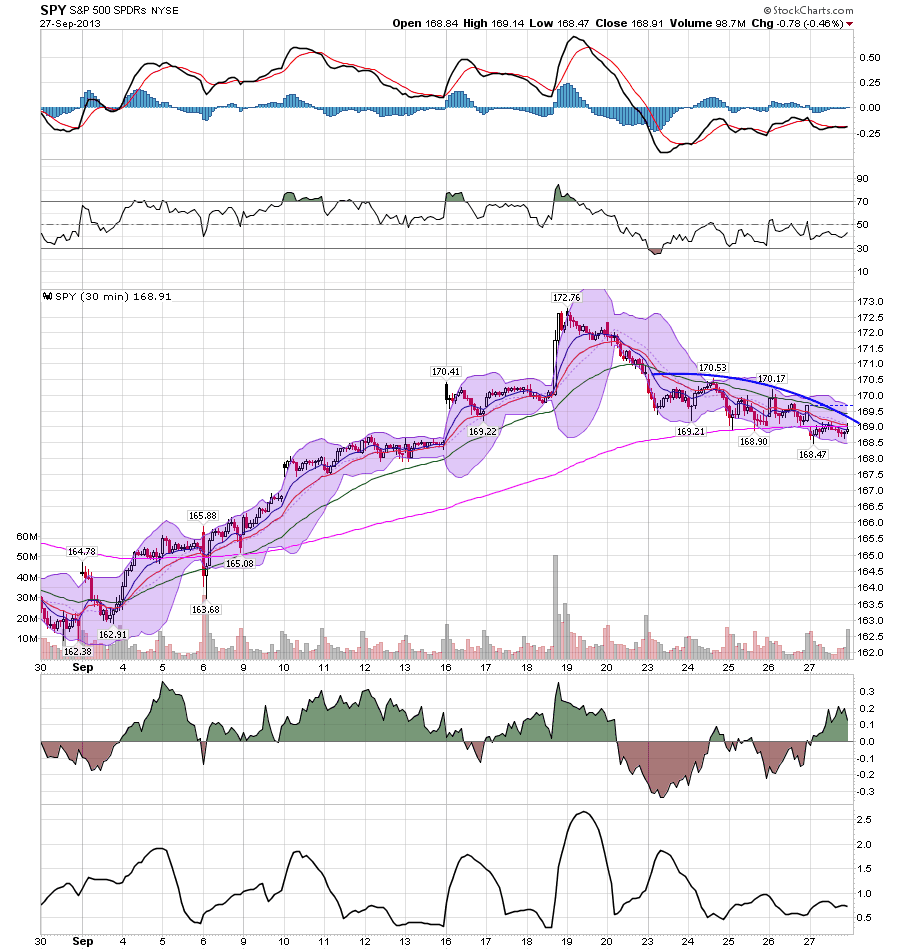
The 60 minute SPY chart shows that last week's price action was simply a sell-off from the rally that lasted from the end of August through mid-September.  Momentum is weak and there isn't much volume flow into the market.


The 30 minute chart shows the heavy technical damage was done at the end of the week of September 10-23; last week's price action was really more of a gentle move lower.


Remember that on the daily chart, we have two somewhat bearish trends in play.  The first is a weakening of momentum; note the decrease in the MACD's highs over the last 3-4 months.  Second, the price arc is moving a bit more sideways now rather than printing an increase.


There are two technical events occurring in the long end of the treasury market.  The first was the sell-off caused by the Fed's taper announcement.  Here we see prices drop from 123 to 101 (a drop of about 18%) which included a move through the technically important 113 and 105-106 level.  Since then prices have "rallied" and are looking for a natural upside resistance point.  But remember that this is a technical bounce, nothing more.

Read More
Posted in | No comments

Sunday, 29 September 2013

'Breaking Bad' finale predictions

Posted on 08:00 by Unknown

- by New Deal democrat

Because I did so well a few weeks ago ( < /snark> ), here are my predications for tonight's finale of 'Breaking Bad:'

1. Walt will die (okay, that sounds pretty easy). I saw a post where "Felina" was the name of a girl in a song. The boy returns to El Paso for her and is killed in a hail of gunfire. So that's my guess for Walt's demise.

2. Walt himself is the one who writes "Heisenberg" on the wall of his house. It's his final way of saying "Remember my Name."

3. We, and Flynn, will find out that he is the reason Walt left Gray Matter. Why did Walt Jr. have to have cerebral palsy, for purposes of the plot line? Because his medical bills are why Walt Sr. accepted the stock buyout way back when. It also fits with his oft-stated line that everything he has ever done, he has done for his family.

4. Somehow Walt's true crucial role in Gray Matter will be recognized publicly. This may involve the poisoning of Walt's former partners.

5. Flynn/Walt Jr. will die. I envision his death will be sudden, wanton, and done for almost trivial purposes, like the killing of the college kid on the couch at the begining of "Pulp Fiction." It will probably be done right in front of Walt Sr. and possibly Skyler. It will be the final, biggest punch in the gut to Walt Sr. and to the audience. The ultimate price will be paid, by the one main character who has remained purely good throughout the series. And as I said last time, there is an innocent dead boy in the desert who must be atoned for. I am guessing the same person will be the triggerman.

6. Todd will get the ricin after shooting Flynn. Walt will con him into smoking the cigarette after Flynn is murdered.

7. Marie will survive and will raise Holly.

8. I don't know what will happen with Skyler, but she will not be alive and scot free at the end of the episode.

9. Finally, Jesse Pinkman will also survive. He is the one character who, against all others, has "broken good." Interestingly, the only evidence of his guilt -- his confession -- is not known to anybody still alive in law enforcement. Should his confession tape be destroyed, there is no real evidence against him. And although he too has done many bad things in the past, there is a morally fair way for him to walk free: the government needs him as a witness against everybody else involved in the entire two year long set of conspiracies, and he gets blanket immunity in return. The final shot of the series is Jesse, with Brock, driving off to Alaska.
Read More
Posted in | No comments

Leave comments here

Posted on 05:53 by Unknown
I've turned comments back on, but it doesn't work for pieces already posted.

So if you have a comment about the new blog style, or my "Thought for Sunday," leave it here.
Read More
Posted in | No comments

A thought for Sunday: an undemocratically elected minority of anarchists

Posted on 05:01 by Unknown

- by New Deal democrat

An old cynical political saw says that, "in a democracy, people get the government they deserve." As it appears more and more likely not just that the government will shut down, but the United States will actually default on paying its debt obligations, it is worth recognizing that in this case, the old saw is wrong. In this case, a majority of voters cast their votes against the party that has vowed to shoot hostages if it does not get its way.

Simply put, we do not have a representative Congress. An extremist minority has erected barriers against actual majority representation. The elections of 2010 through 2012 have shown that electing a GOP majority at the state level is the last fair election that a state will have. This extremist party will redistrict - even in mid-decade - to ensure that it will retain control of the state legislature, and House Congressional districts representing that state, even if a solid majority of the population of that state votes against them in future elections.

That means that the Congress which is about to close down the federal government - which will cost billions of dollars by itself; the Congress which appears ready to default on payment of debts it already contracted for; is not a representative democratic body. It is a fundamentally unrepresentative body of a determined anti-democratic minority. It is and ought to be universally understoods as anathema.

Let's start with the Senate. According to the blog Matlab Geeks, a higher percentage of the US population has been represented by democratic Senators in all but two elections since 1980:

Photobucket Pictures, Images and Photos

As of 2012, 55% of the US population was representated by democratic Senators. Only 45% was represented by GOP Senators.

But because of the filibuster, that 55% consistently has its will thwarted. As set forth by Middle Class Political Economist:
Under the Senate's filibuster rules, 41 Senators can block debate on Senate bills and nomination confirmations.... [So] what percentage of the 50-state population is represented by the 41 Republican Senators from the least populous states. The answer takes the actual population of states with any Republican Senators, except Texas (Cornyn and Hutchison), Florida (Rubio), Illinois (Kirk), Pennsylvania (Toomey), and Ohio (Portman).  The population of the states represented by the other 41 Republican Senators is 104.7 million, or 34.0% of the population of the 50 states.
(emphasis mine)

Although the filibuster has become an inexcusable anti-democratic tool, at least it can be said that by design the Senate was erected as a federalist check on the direct popular will.

No such excuse can be made as to the House of Representatives.

Because of gerrymandering, the House also has become perversely unrepresentative of the US population. The democratic party in this Congress has 35 fewer seats than the GOP, even though the democratic party won an outright national majority of the the House vote. Here's how unrepresentative the House vote in 2012 was, as shown in a graph prepared by Princeton Neuroscience Professor Sam Wang:

Photobucket Pictures, Images and Photos

Just how undemocratic is the representation in the House of Representatives? Based on his calculations, Wang concluded:
Based on how far the red data point is from the black prediction line, the “structural unfairness” may be higher – as much as 5% of the popular vote. That is incredible. Clearly nonpartisan redistricting reform would be in our democracy’s best interests.
So it cannot be said in any fair sense that the Congressional hostage-takers are at least representing the will of the people. They are not. In the Legislative Branch of government, the US is no longer a representative democracy. It is under the control of an unrepresentative, undemocratically elected minority of willful extremists. That is why the US is on the brink of a fiscal crisis.
Read More
Posted in | No comments

Saturday, 28 September 2013

Weekly Indicators: are consumers voting against Washington idiocy? edition

Posted on 06:15 by Unknown

 - by New Deal democrat

Monthly data reported this past week included August personal income, spending, and savings, all up. Case=Shiller home prices increased, as did new home sales. Durable goods were essentially flat. The Conference Board's consumer confidence index declined, but the U. Michigan consumer confidence index increased.

We are told that the September jobs report may not get published on Friday if the government shuts down. Two years ago, during the debt ceiling debacle, it was consumer spening holding up that told me that the economy would not tip back into recession. Consumers may be behaving differently this time around. Let's start this edition of the high frequency weekly indicators by looking at that:

Consumer spending
  • ICSC -1.0% w/w +1.6% YoY

  • Johnson Redbook +3.9% YoY

  • Gallup daily consumer spending 14 day average at $85 up $9 YoY
In the last month, Gallup's 14 day average of consumer spending has become much less positive than earlier this year, and this week was the poorest YoY comparison yet. This was also one of the poorest weeks for absolute spending this year (although we need to be careful with that, since mid-autumn typically is weak). Last year the ICSC varied between +1.5% and +4.5% YoY in, while Johnson Redbook was generally below +3%. The ICSC had one of its weakest 2013 readings this week. Johnson Redbook, however, remains at the high end of its range, and has actually been improving.

Steel production from the American Iron and Steel Institute
  • +1.8% w/w

  • +7.2% YoY

Steel production over the last several years has been, and appears to still be, in a decelerating uptrend. It had been negative YoY, but turned positive two weeks ago.

Transport

Railroad transport from the AAR
  • -4300 carloads down -1.5% YoY

  • +1200 carloads or +0.7% ex-coal

  • +8600 or +3.4% intermodal units

  • +4400 or +0.8% YoY total loads
Shipping transport
  • Harpex unchanged at 403

  • Baltic Dry Index up +142 to 2043
Rail transport had been very mixed YoY during midyear, but this week was the seventh positive week in a row since then. The Harpex index had been improving slowly from its January 1 low of 352, but has generally flattened out for the last few months. The Baltic Dry Index has rebounded to make nearly a 3 year high. In the larger picture, both the Baltic Dry Index and the Harpex declined sharply since the onset of the recession, and have been in a range near their bottom for about 2 years, but stopped falling earlier this year, and now are in uptrends.

Employment metrics

Initial jobless claims
  • 305,000 down -4,000

  • 4 week average 308,000 down -6750

The American Staffing Association Index was up 2 to 100. It is up +5.1% YoY

Tax Withholding
  • $139.6 B for the first 13 days of September vs. $125.2 B last year, up +14.4 B or +11.5%

  • $150.3 B for the last 20 reporting days vs. $135.2B last year, up +15.1 B or +11.1%

We can now estimate that after adjusting for state reporting glitches, one week ago initial jobless claims were ~327,000, still a 6 year low, and the 4 week average was 325,250. Jobless claims remain firmly in a normal expansionary mode. Like each of the last three years that this same, a good, downside breakout has occurred.

Temporary staffing had been flat to negative YoY in spring, but has broken out positively in the last two months. The only time it has ever been higher was one week in 2006 and in the second half of 2007. Tax withholding, after a relatively poor August, is again posting better (but just average) comparisons.

Oil prices and usage
  • Oil down -$1.88 to $102.87 w/w

  • Gas down -$0.05 at $3.50 w/w

  • Usage 4 week average YoY up +0.9%
The price of Oil continued its retreat from its recent 2 year high. The 4 week average for gas usage is slightly positive again.

Interest rates and credit spreads
  • 5.49% BAA corporate bonds down -0.05%

  • 2.79% 10 year treasury bonds -0.13%

  • 2.70% credit spread between corporates and treasuries up +0.08%
Interest rates for corporate bonds had been falling since being just above 6% in January 2011, hitting a low of 4.46% in November 2012. Treasuries fell to a possible once-in-a-lifetime low of 1.47% in July 2012, and have decisively risen about 1.5% above that mark. Spreads retreated from last week's 2 year low. Their recent high was over 3.4% in June 2011.

Housing metrics

Mortgage applications from the Mortgage Bankers Association:
  • +7% w/w purchase applications

  • +7% YoY purchase applications

  • +5% w/w refinance applications
Refinancing applications have decreased sharply in the last 5 months due to higher interest rates. Purchase applications have also declined from their multiyear highs in April, but remain slightly up YoY.

Housing prices
  • YoY this week +10.9%
Housing prices bottomed at the end of November 2011 on Housing Tracker, and averaged an increase of +2.0% to +2.5% YoY during 2012. This weeks's YoY increase remains near a 7 year record.

Real estate loans, from the FRB H8 report:
  • +0.2% w/w

  • -0.7% YoY

  • +1.4% from its bottom
Loans turned up at the end of 2011 and averaged about 1% gains YoY through most of 2012.  Over the last few months, the comparisons stalled and now have turned negative.

Money supply

M1
  • -0.1% w/w

  • +0.7% m/m

  • +6.2% YoY Real M1

M2
  • unchanged w/w

  • +0.4% m/m

  • +4.9% YoY Real M2
Real M1 made a YoY high of about 20% in January 2012 and decelerated since then. Earlier this year it increased again but this week it tied its new 2 year low from last week (although it is still positive).  Real M2 also made a YoY high of about 10.5% in January 2012.  Its subsequent low was 4.5% in August 2012. It increased slightly in the first few months of this year, then stabilized, but has declined again in the past several months.

Bank lending rates
  • 0.243 TED spread down -0.003% w/w

  • 0.180 LIBOR up +0.001 w/w
The TED spread is still near the low end of its 3 year range, although it has risen slightly in the last few months.  LIBOR established yet another new 3 year low during this week.

JoC ECRI Commodity prices
  • down -0.73 to 123.76 w/w

  • -0.54 YoY

The overall story this week remains as it has been for the last several months. The long leading indicators of interest rates, mortgage refinance applications and real estate loans have all turned negative, although they were less so this week. Purchase mortgage applications do remain slightly positive YoY. Money supply is also decelerating although still positive. Spreads between corporate bonds and treausries also were negative again this week.

The shorter leading indicators of initial jobless claims are very positive, even adjusting for California's computer problems. Temporary employment has turned strongly positive in the last two months. The oil choke collar has disengaged. Commodities are neutral.

The coincident indicators of transportation -- rail traffic and shipping - remain positive. Steel production is positive. Bank lending rates are at or near or at record lows. Tax withholding has also improved moderately in the last couple of weeks. House prices remain strongly positive.

A new concern, however, has to be consumer spending. Both Gallup and the ICSC have become quite weak, although still positive. Johnson Redbook, on the other hand, is strongly positive. Two years ago, during the debt ceiling debacle, it was consumer spending especially as reported by Gallup, that showed that consumers were voting very positively with their wallets, and we were not slipping into a double-dip recession. With Washington once again on the verge of destroying economic growth, higher interest rates may be causing the consumer to spend much more cautiously. This is really unfortunate because left to its own devices, the economy appears to be picking up steam for the rest of the year. I still remain much more cautious about 2014.

Have a nice weekend!
Read More
Posted in | No comments

Friday, 27 September 2013

Weekend Weimar, Beagle and Pit Bull

Posted on 12:30 by Unknown


Read More
Posted in | No comments

Japan Continues To See Inflationary Increase

Posted on 10:30 by Unknown
While it seems odd to talk about increased inflation as a good economic development, for Japan it is.  For the last 15 years they have been dealing with a prolonged period of deflation, which has led to at least one lost decade.  About this time last year, Japan's new leader Abe introduced a plan to return Japan to a period of economic growth, which included the Bank of Japan doubling the monetary base in the period of a year.  That policy is now having the desired effect of lowering the value of the yen, leading to increased import prices and hence a rise in prices.

Japan's core consumer inflation in August hit its highest level in nearly five years, while prices of personal electronics rose for the first time since 1992 - signs Japan may be emerging from 15 years of nagging deflation.

Core consumer prices, which include oil products but exclude volatile prices of fresh food, rose 0.8 percent in August from a year earlier after a 0.7 percent increase in July, marking the third straight month of gains.

It was the fastest rise since November 2008, when core consumer inflation hit 1 percent reflecting a spike in global commodity prices, government data showed on Friday.

But most of the increase was caused by rising gasoline costs and a weaker yen that inflated the price of food imports and may dampen consumer sentiment, which is already showing signs of peaking.

That said, prices of durable leisure goods, such as personal computers and audio-visual equipment, rose 0.1 percent in August from a year earlier, turning positive for the first time since 1992, in a sector where consumer prices have fallen steadily.
Read More
Posted in Japan | No comments

Europe Catching a Bid

Posted on 07:00 by Unknown
The recent news out of the EU region has been positive.  While it's still to early to say that a positive trend is in place, the news has been encouraging.  As a result, we've seen the region's ETFs catch a bid.


All of the above charts show the four largest economies and developing regions are at or near six month highs.
Read More
Posted in | No comments

The economy has almost completely recovered (the people in it, not necessarily so much)

Posted on 06:30 by Unknown

. - by New Deal democrat

This morning's release of personal income and spending completes the monthly reports for the 4 big coincident indicators for the economy, shown in the graph below, in which the pre-great recession peaks are normed to 100: Industrial production (blue), payrolls (red), real retail sales (green), and real personal income ex transfer payments (orange):

Photobucket Pictures, Images and Photos

Personal income rose 0.4% in August, and the PCE deflator only rose 0.1%, so real personal income rose 0.3%. July's number was also revised higher by 0.1%.

Real GDP completely recovered to its pre-recession highs over a year ago. As shown in the graph above, both real income and real retail sales are also above their pre-recession peaks. Payrolls, which contracted by over 8 million jobs, are about 1.6 million from their pre-recession peak. At 160,000 jobs a month, it will take us 10 more months to exceed that peak. If the +345,000 preliminary upward revision by the BLS for the last year sticks, it will take 8 more months. Finally, industrial production has made up all but 1.7% of its 17% loss during the recession. Depending on how you measure its trend from the June 2009 bottom, it should exceed its pre-recession peak in about 5 to 8 months.

Since the short leading indicators for the economy suggest that there will be a little more strength in the next 6 months or so, it looks very much like the economy will have fully recovered by sometime next spring. Should that come to pass, then at that point we'll no longer be talking about economic recovery, but simply economic expansion.

Where there's been not so much of a recovery, of course, is when you measure per capita, and in particular by population-adjusted job creation, and in median wages. The economy is actually doing pretty good, the average American in it, not necessarily so much.
Read More
Posted in | No comments

India Raises Rates 25 BP

Posted on 04:00 by Unknown
Last week, the new head of the Reserve Bank of India issued his first policy statement, raising rates 25 basis points while reducing some of the extraordinary measures put into place over the last few months to halt currency outflows.  While many news outlets reported this as a startling development, a sober look at the data would reveal this move was hardly controversial.  First, while inflation dipped in the earlier part of the year (4%-6%), it has since been rising, approaching the higher levels (7%+) seen last year.  Second, the head of the Bank is new, and he would want to establish his inflation fighting credentials for the markets specifically and the economy at large generally.  Seen in the light of these two facts, the move should have been anticipated.  For background on the India situation see these posts: here, here, here and here.

Here are some salient points from the points from the policy announcement:

On the domestic front, growth has weakened with continuing sluggishness in industrial activity and services. The pace of infrastructure project completion is subdued and new project starts remain muted. Consumption, while relatively firm so far, is starting to weaken even in rural areas, with durable goods consumption hit hard. Consequently, growth is trailing below potential and the output gap is widening. Some pick-up is expected on account of the brightening prospects for agriculture due to kharif output and the upturn in exports. Also, as infrastructure investments are expedited, and as projects cleared by the Cabinet Committee on Investment come on stream, growth could pick up in the second half of the year.

WPI inflation, which had eased in Q1 of 2013-14, has started rising again as the pass-through of fuel price increases has been compounded by the sharp depreciation of the rupee and rising international commodity prices. The negative output gap will exercise downward pressure on inflation, and the process will be aided as supply side constraints, especially relating to food and infrastructure, ease. However, the current assessment is that in the absence of an appropriate policy response, WPI inflation will be higher than initially projected over the rest of the year. What is equally worrisome is that inflation at the retail level, measured by the CPI, has been high for a number of years, entrenching inflation expectations at elevated levels and eroding consumer and business confidence. Although better prospects of a robust kharif harvest will lead to some moderation in CPI inflation, there is no room for complacency. 


Read More
Posted in India | No comments

Thursday, 26 September 2013

Making Sense of the Durable Goods Numbers

Posted on 08:30 by Unknown
Over the last few months, the durable goods numbers have printed some very wide results.  Let's look at the data to make sense of what we're seeing:


Above is a table from the latest report. The new orders numbers have been all over the place: we see a 3.9% increase followed by an 8.1% decrease followed by a .1% increase.  So -- what's really going on?

I still think the data ex-transportation is really the best number to look at.  And in that category we see that orders ex-transportation increased .1%, decreased .5% and then decreased .1%.  These data points tell us that transportation orders are responsible for a tremendous amount of statistical noise. 
Read More
Posted in | No comments

Initial claims last week ex-California computer glitch ~327,000

Posted on 06:30 by Unknown

- by New Deal democrat

Computer issues in California continue to bedevil the weekly initial jobless claims reports. We can make a good estimate of what the "real" initial jobless claims have been, however, by excluding California, comparing the unadjusted average for the other 49 states this year vs. last year in the same week, and projecting this year's "real" number by assuming that the percentage of claims in the other 49 states are the same percentage of the total this year as they were last year. I used this technique last autumn in the wake of Superstorm Sandy to show that "real" initial jobless claims were actually declining slightly -- a trend that proved correct once the distortions disappeared from the data in a few weeks.

Keep in mind that the week I am adjusting in this post is last week's report, since there is a one week delay in the Department of Labor's posting of state by state numbers. So the "real" number I have estimated is comparable to last week's 310,000, not this week's 305,000.

Last year this same week total unadjusted jobless claims were 330,454 vs. 272,918 this year. Of last year's total, 61,421 were California claims vs. 40,657 this year. This gives us a 49 state comparison of 269,033 last year vs. 232,261 this year. That makes this year's 49 state number 86.3% of last year's 49 state number.

Last year, after seasonal adjustment, the report for September 15 was 379,000. Multiplying that by 0.863 gives us just over 327,000.

Last week I estimated that the "real" initial claims number for the week of September 7 was ~318,000 vs. 294,000 as reported. This means that the "real" 4 week moving average of initial claims this week is 325,250 vs. the reported 314,500.

This is still the best 4 week average in 6 years, since October 13, 2007, and it indicates that, even after we adjust for the computer glitches, the trend in initial jobless claims is still improving.
Read More
Posted in | No comments

What Happened to the Perp Walk?

Posted on 05:57 by Unknown
It used to be that prosecutors were dead set on making someone take the "perp walk."  This occurred when an individual was arrested by the authorities and taken outside to a giant crowd of reporters, all of whom snapped pictures and shouted questions.  The prosecutors would then issue press releases about the trial's progress, eventually leading to a criminal sentence where somebody important would end up going to jail.

Now we learn that BP has paid a $4.5 billion dollar fine as part of the Gulf of Mexico oil fire and that JP Morgan is in talks to settle all its outstanding issues for $11 billion.  This is in addition to JPM's $5.3 billion in fines already paid.  The size of these fines means there's a ton of provable fraud going on. 

Here's the problem: paying a fine -- while high -- is now becoming a simple cost of doing business.  Until important people start going to jail for meaningful amounts of time, we will continue to see criminal behavior.

It's time for the US attorneys office to grow a pair and start sending important people to jail.


Read More
Posted in | No comments

UK Economy Continues To Look Promising

Posted on 04:00 by Unknown
From the minutes of the latest Central Bank Meeting:

The estimate of GDP growth in the second quarter had been revised up a little to 0.7% in the second release. The initial estimates of the expenditure breakdown had suggested that growth had been fairly broadly based, with investment and export growth both a little stronger than the Committee had anticipated. Such initial estimates for the expenditure components were, however, highly uncertain. There were other reasons for caution. For instance, the strength of exports was concentrated in a couple of subsectors and appeared erratically strong by comparison with the growth of world trade volumes during Q2; and the large positive contribution to growth from stockbuilding would probably prove transient, especially if it were simply a bounceback from the temporary de-stocking observed in the first quarter.

Nevertheless, that modestly promising data release had been augmented by the continuing strengthening of the indicators of consumer spending in 2013 Q3 and further strong business surveys in August. The Markit/CIPS services activity index was broadly unchanged in August, after having increased sharply in July, and the manufacturing and construction indices had strengthened further. Consequently, the composite PMI was at its highest level since 1997. The CBI service sector survey had also strengthened in August. Overall, Bank staff estimated that the initial estimate of output growth in the third quarter would be around 0.7%, compared with the 0.5% expected at the time of the August Inflation Report. Moreover, the early indicators for activity in Q4 tentatively suggested further strengthening towards the end of the year. Overall, these data provided further evidence in support of the pickup in growth assumed at the time of the August Inflation Report and, if anything, posed an upside risk to that path.

Since the spring, and after several years of stasis, activity in the housing market had been picking up and, on the basis of recent indicators, gaining momentum. Although still well below pre-crisis norms, monthly mortgage approvals had increased by almost a third over the past year. And, according to the average of the main lenders’ indices, nominal house prices in July stood around 4% higher than a year earlier and so had begun rising in real terms for the first time since mid-2010. In a confidential preview of the survey, the RICS current house price balance had risen to a level last seen at the end of 2009. There had also been signs of an easing in conditions in the commercial property market.


Let's look at the major macro-level data to elaborate on the above.

GDP annual growth rate appeared to be stalling 1-3 quarters ago, printing at the 0$ and .1% level.  But the latest reading has the annual growth rate at 1.5%.

The inflation rate has been consistently printing in the 2.5%-2.8% range for the last year.

Like the US, the UK has had a stubbornly high unemployment rate, coming in at 7.7%+ for the last year.

While there current account gap is negative, the UK prints their own currency, making this a problem the country can deal with.

The government budget deficit has been decreasing as well.

Let's see how this is translating in the relevant market action.


The pound has been rallying since the beginning of July, finally rising about the 200 day EMA in early September.  The shorter EMAs are now above the 200 day EMA as well.


The UK ETF broke through resistance in the lower 19 area in early September as well.  Prices have fallen back a bit since then, but that's to be expected after a strong move higher.


Read More
Posted in UK | No comments

Wednesday, 25 September 2013

Gas price trend nears its best in a decade

Posted on 10:30 by Unknown

- by New Deal democrat

The secular rise in the price of gasoline from a low of $0.80 in 1999 to $4.25 in 2008, and its continual high price over $3.20 for the last 2 1/2 years is one of the big overlooked stories of the great recession and its aftermath.

At the moment, with concerns about the middle east receding somewhat, the price of gas has declined almost 10% from one year ago at this time. Here's the graph of the YoY trend since the secular price increase started:

Photobucket Pictures, Images and Photos

We've only had this kind of price retreat towards the end of both of the last recessions, and also during the weakness of late 2006. This respite is possibly goiong to give us consumer price inflatioin of less than 1% YoY for September. That would be the lowest outside of the great recession, and a temporary help to consumers.
Read More
Posted in | No comments

In case you were wondering . . .

Posted on 06:01 by Unknown
- by New Deal democrat

As you can see, the blog looks a wee bit different. Here's what happened.

In the course of shutting down comments for a few days to deal with the spammer, one of us -- or possibly both of us simultaneously! --- accidentally nuked the old format. Apparently it's a legacy format that is no longer available for new blogs. So once it was nuked, it was gone forever.

I played around for awhile yesterday trying to replace the boring "classic" format with something that was at least similar to the one we lost, and what you see is the closest I was able to come up with. I was shooting for "Close Encounters of the Third Kind" script, but I seem to have wound up with something closer to "Miami Vice."

Anyway, we both kind of like the new format, but don't be surprised if there are some further changes by next week. I'd tell you to leave comments, but those are still temporarily shut off. Once they're turned back on, feel free to tell us what you like and what you hate.

From Bonddad:

I'm wondering who's Crocket and who's Tubbs....
Read More
Posted in | No comments

Employment Burns While Washington Fiddles

Posted on 04:00 by Unknown
Over the next few weeks/months, we'll be witnessing another round of incredible budget stupidity from Washington.  As we see that, let's also remember that an issue they should be dealing with  -- the terrible unemployment situation in the US - has not been talked about or dealt with in any way over the last several years.

The good news on employment is the leading indicators of employment are strong.


The four week moving average of initial unemployment claims has been dropping consistently since spiking at the end of the recession, and is now printing below 320,000.


Temporary help is rising at strong rates.

However, that is where most of the good news ends.  First, there is little confidence in the employment situation as evidenced by the following.


People are quitting at low rates.  If employees thought there was a high prospect of a job around the corner, we'd see this number at higher levels.  But people aren't quitting their jobs, which tells us they are concerned that if they quit, they won't be able to find another job.


At the same time, hiring plans surged in the latest NFIB report.  However, this is one month of data, and this data point is at odds with other data points in the small business survey report.

And employers are being very cautious in their hiring.


Total non-farm employment has been increasing over the last few years.  But it's still 2,000,000 below the highest level of the latest expansion.


The above data is from the JOLTs survey.  Job openings (in blue) cratered during the recession, but has since bounced back.  However, hires have stalled for the last year and a half at levels below the lowest level of the previous recession.

And finally there is this:


The US labor force is being horribly underutilized right now. 

Here's the bottom line.  For the last three years, the budget bullshit has taken precedence in Washington.  No one is talking about dealing with unemployment on either side of the aisle.  And that is the real crime.

Read More
Posted in | No comments

Tuesday, 24 September 2013

Corporate Bond Market Selling Off With Treasury Market

Posted on 12:30 by Unknown

Above is a chart of the short (SHY, VCSH), intermediate (VCIT, IEF) and long term (VCLT, TLT) bond ETFs for both the corporate and treasury market.  As the treasury market has sold off, the corresponding corporate bond ETF has sold off as well.


Above is a chart of the short, intermediate and long term corporate bond market yield from the FRED system, which shows the same situation.
Read More
Posted in | No comments

Germany Heading In The Right Direction

Posted on 08:30 by Unknown
From the latest Markit press release:

Output growth accelerated for the fourth month running in September, helped by a further upturn in new orders, which highlighted that the German private sector economy gained further momentum at the end of the third quarter. Meanwhile, net job creation returned in September and, although only marginal, the pace of employment expansion was the most marked since March 2012.
 

At 53.8 in September, up from 53.5 in August, the seasonally adjusted Markit Flash Germany Composite Output Index pointed to a solid rise in business activity, with the pace of expansion the fastest since January. The index has now posted above the neutral 50.0 threshold for five months in a row.

And business confidence is also picking up:


Let's see how this information is effecting the markets.


First, Europe in general is rallying.  The IEVs broke through resistance at 43 several weeks ago and continued to move higher.  The shorter EMAs are rising and providing technical support for the move higher.  Momentum overall is positive.


The German ETF is in a slow uptrend, printing continually higher highs (see arrows at 25, 26 and 27).  The 200 day EMA is providing long-term support for the rally.  Momentum is ebbing and flowing but staying in a positive range. 
Read More
Posted in Germany | No comments

New Home Sales Stalling Under Higher Rates

Posted on 04:30 by Unknown
One of the bright spots for the US economy has been a rebounding housing market.  Depressed for the last four years as it worked off the massive excess of the housing bubble, the market has recently been rebounding.  Let's look at the data to see exactly what's been happening as of late.


New home sales dropped sharply in the latest report.  In addition, recent economic activity was revised lower.  While one month of data is too little data on which to draw a conclusion, anecdotal reports from several sources have indicated the recent increase in rates in having a negative effect on purchasers.


The above chart shows the numbers for housing permits in blue) and housing starts (in red) for the last year.  The numbers have been cresting.  However,


Placed in a larger context, we see that housing starts and permits, after rising since the beginning of 2011, are moving slightly lower.  This, again, is most likely due to the effects of higher rates.


Read More
Posted in | No comments

Monday, 23 September 2013

Comments Are Off Until DAN KENNEDYS LIFESTYLE LIBERATION BLUEPRINT STOPS SPAMMING OUR BLOG

Posted on 16:52 by Unknown
For the last 24 hours, Dan Kennedy's Lifestyle Liberation Blueprint has been spamming our comments section.  So, until this utterly worthless website, whose content we do not endorse stops attempting to promote their worthless and contemptible site on our blog, comments will be off.

Read More
Posted in | No comments

Chinese Rebound Continues

Posted on 11:30 by Unknown
There was a great deal of concern among economists and market participants earlier this year over China, or, more specifically, the then emerging slowdown in the Chinese economy.  However, recent data indicates the slowdown has passed. 

From the latest HSBC report:

Here's a chart of the Chinese market:


The market dropped sharply in June, falling to ~1950 with an intra-day move down to 1850.  However, prices have been moving steadily higher since then, crossing the 200 day EMA the week before last.  Last week's large daily sell-off looks as must technical as anything else.
Read More
Posted in | No comments

Oil Is Still At High Levels

Posted on 08:30 by Unknown

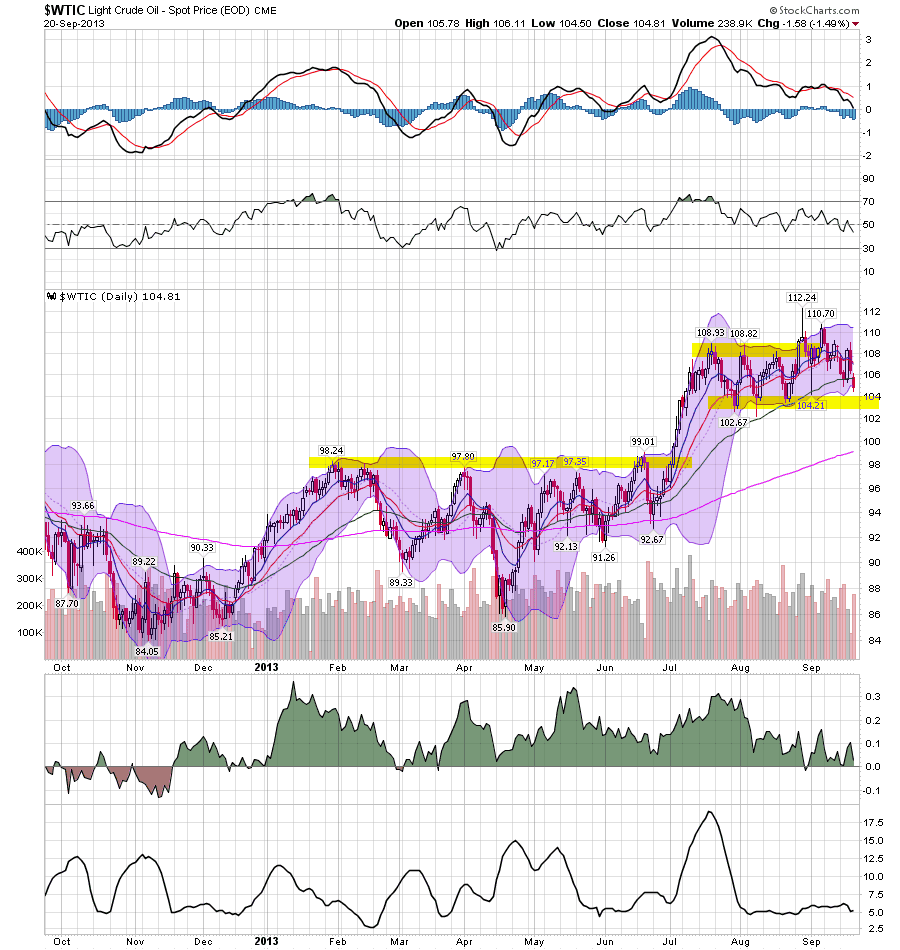
Oil has been trading at high level (over the 102/104 area) for almost two months.  While the chart is telling us that a sell-off is on the way (dropping MACD, weakening CMF, prices below all the shorter EMAs) we're not there yet. 
Read More
Posted in | No comments

Economic/Market Analysis: US

Posted on 04:00 by Unknown
The best news of the week came from the Conference Boards LEI and CEI release:

The Conference Board LEI for the U.S. increased in August for the second consecutive month. The improvement in the LEI was driven by positive contributions from the interest rate spread, ISM® new orders, average workweek and lower initial claims for unemployment. In the six-month period ending August 2013, the leading economic index increased 2.1 percent (about a 4.3 percent annual rate), marginally faster than the growth of 2.0 percent (about a 4.1 percent annual rate) during the previous six months. In addition, the strengths among the leading indicators have been more widespread than weaknesses in recent months.

The Conference Board CEI for the U.S., a measure of current economic activity, also improved in August. The index rose 0.9 percent (about a 1.9 percent annual rate) between February and August 2013, slower than the growth of 1.2 percent (about a 2.3 percent annual rate) for the previous six months. However, the strengths among the coincident indicators have remained very widespread, with all components advancing over the past six months. The lagging economic index continued to increase, but at a higher rate than the CEI. As a result, the coincident-to-lagging ratio is down slightly. Real GDP expanded at a 2.5 percent annual rate in the second quarter of the year, after increasing 1.1 percent (annual rate) in the first quarter.

Here's a table of the last 6 months of readings:

One of my concerns with this data series over the last few months has been its weakening internal condition, as a larger number of the individual data points printed in the negative.  Last month, the only negative reading came from building permits.

The housing market also provided us with important information.  First, existing home sales increased 1.7% with 4.9 months of inventory available.  The good news here is that sales keep increasing, but we're also seeing an uptick in inventories, which will eventually help to ease price increases.  Housing starts increased .9%.  While this number is positive, it's been stabilizing at current levels for the last several months.  I'll have more on this later this week.  Finally, the NAHB homebuilders index was unchanged at 58.   

Last week there was a ton of information released on the industrial sector, starting with the .4% increase in industrial production.  The increase was broad-based, with all sectors save utility output expanding.  Capacity utilization also increased, but remember that its level is still below pre-recession peaks. The Empire State manufacturing index decreased, but still printed a positive number at 6.3.  This number has been fairly weak for most of the year.  In contrast was the Philly Fed manufacturing index, which increased strongly, moving from 9.3 to 22.3.  New orders and shipments also increased sharply.  The balance of the IP news (which is a coincident economic indicator) was positive.

The overall tenor of the news this week was positive.  It appears the manufacturing sector is trying to advance beyond its recent doldrums.  Housing is slowing, but that would be a logical development considering the increased rate environment we are now seeing.  I wouldn't be surprised to see the industry eventually pause at current levels of activity as a result of higher interest rates.  Finally, the LEIs were a welcome development as they indicate forward economic momentum is occurring.

Let's turn to the markets.


There's good and bad news on the SPY chart.  The good news is it printed a new high last week, the third in a successive period of higher highs (see the 167 print in May, 170 in early August and 172 last week).  However, notice the rate of increase (the arcing blue line above prices) is becoming less steep, indicating momentum is decreasing.  I'm beginning to think we're going to end the year close or slightly above current levels.


Last week we saw both the belly of the curve (IEFs, top chart) and long end (TLTs, bottom chart) rally in reaction to the Fed announcing it won't taper this month.  But both of these are temporary aberrations.  While there will be no tapering this month, it is sure to happen at some time with the likely occurrence being sooner rather than later.  As such, the real issue for the above ETFs is whether support holds at current levels.


Read More
Posted in | No comments

Saturday, 21 September 2013

Weekly Indicators: Aroma's Coffeehouse edition

Posted on 07:30 by Unknown

 - by New Deal democrat

This week's edition of Weekly Indicators is coming to you from one of my favorite places in the whole world, Aroma's Coffeehouse in Colonial Williamsburg.


Month over month August data included the Index of Leading Economic Indicators, up strongly, suggesting good growth for the next 6 to 8 months. Industrial production improved to a post-recession high, capacity utilization was up, the Philly manufacturing index improved, although the Empire State index decelerated. Existing home sales were up. Consumer prices barely budged. A big negative was the decline in housing starts and permits.

Let's again start this edition of the high frequency weekly indicators by looking at the real economic version of the Dow signal, i.e., comparing manufacturing with transport:

Steel production from the American Iron and Steel Institute
  • -1.3% w/w

  • +5.3% YoY

Steel production over the last several years has been, and appears to still be, in a decelerating uptrend. It had been negative YoY, but turned positive one week ago.

Transport

Railroad transport from the AAR
  • +8300 carloads up +1.5% YoY

  • +12,700 carloads or +7.7% ex-coal

  • +13,300 or +4.9% intermodal units

  • +17,300 or +3.1% YoY total loads
Shipping transport
  • Harpex down -3 to 403

  • Baltic Dry Index up +268 to 1904
Rail transport had been both positive and negative YoY during midyear, but this week was the sixth positive week in a row since then, and equals its most positive showing in a long time. The Harpex index had been improving slowly from its January 1 low of 352, but has generally flattened out for the last few months. The Baltic Dry Index has rebounded to make nearly a 2 year high. In the larger picture, both the Baltic Dry Index and the Harpex declined sharply since the onset of the recession, and have been in a range near their bottom for about 2 years, but stopped falling earlier this year, and now seem to be in an uptrend.

Employment metrics

Initial jobless claims
  • 309,000 up +17,000

  • 4 week average 314,750 down -6500

The American Staffing Association Index was up 1 98. It is up +5.1% YoY

Tax Withholding
  • $111.2 B for the first 13 days of September vs. $99.5 B last year, up +11.7 B or +11.8%

  • $148.5 B for the last 20 reporting days vs. $134.0B last year, up +14.5 B or +10.8%

We can now estimate that after adjusting for state reporting glitches, one week ago initial jobless claims were ~318,000, still a 6 year low. Jobless claims remain firmly in a normal expansionary mode. Like each of the last three years that this same, a good, downside breakout has occurred.

Temporary staffing had been flat to negative YoY in spring, but has broken out positively in the last two months. Tax withholding, after a relatively poor August, is again posting better comparisons.

Consumer spending
  • ICSC -1.6% w/w +3.2% YoY

  • Johnson Redbook +3.4% YoY

  • Gallup daily consumer spending 14 day average at $81 up $9 YoY
Gallup's 14 day average of consumer spending is positive, but significantly less so than earlier this year. The ICSC varied between +1.5% and +4.5% YoY in 2012, while Johnson Redbook was generally below +3%. The ICSC has been weakening but improved for the second week in a row, and Johnson Redbook remains at the high end of its range, and has actually been improving.

Oil prices and usage
  • Oil down -3.46 to $104.75 w/w

  • Gas down -$0.04 at $3.55 w/w

  • Usage 4 week average YoY down +0.6%
The price of Oil continued its retreat from its recent 2 year high. The 4 week average for gas usage turned slightly positive, after two weeks of being slightly negative.

Interest rates and credit spreads
  • 5.54% BAA corporate bonds up +0.05%

  • 2.92% 10 year treasury bonds unchanged

  • 2.57% credit spread between corporates and treasuries up -+0.05%
Interest rates for corporate bonds had been falling since being just above 6% in January 2011, hitting a low of 4.46% in November 2012. Treasuries fell to a possible once-in-a-lifetime low of 1.47% in July 2012, and have decisively risen about 1.5% above that mark. Spreads, however, made another new 2 year low this week. Their recent high was over 3.4% in June 2011.

Housing metrics

Mortgage applications from the Mortgage Bankers Association:
  • +3% w/w purchase applications

  • +1% YoY purchase applications

  • +18% w/w refinance applications
Refinancing applications have decreased sharply in the last 4 months due to higher interest rates, although this week's rebound makes up almost all of last week's precipitous decline. Purchase applications have also declined from their multiyear highs in April, but are still ever so slightly up YoY.

Housing prices
  • YoY this week +11.1%
Housing prices bottomed at the end of November 2011 on Housing Tracker, and averaged an increase of +2.0% to +2.5% YoY during 2012. This weeks's YoY increase remains near a 7 year record.

Real estate loans, from the FRB H8 report:
  • unchanged w/w

  • -0.1% YoY

  • +1.2% from its bottom
Loans turned up at the end of 2011 and averaged about 1% gains YoY through most of 2012.  Over the last few months, the comparisons have completely stalled.

Money supply

M1
  • -0.8% w/w

  • -0.2% m/m

  • +5.7% YoY Real M1

M2
  • unchanged w/w

  • +0.2% m/m

  • +5.0% YoY Real M2
Real M1 made a YoY high of about 20% in January 2012 and decelerated since then. Earlier this year it increased again but this week made a new 2 year low (although it is still positive).  Real M2 also made a YoY high of about 10.5% in January 2012.  Its subsequent low was 4.5% in August 2012. It increased slightly in the first few months of this year, then stabilized, but has declined again in the past several months.

Bank lending rates
  • 0.246 TED spread up +0.002% w/w

  • 0.179 LIBOR down -0.002 w/w
The TED spread is still near the low end of its 3 year range, although it has risen slightly in the last few months.  LIBOR established yet another new 3 year low this week.

JoC ECRI Commodity prices
  • up 1.22 to 124.75 w/w

  • -0.13 YoY

This week was generally positive, with the same concerns about the long leading indicators as I've had for the past several months. Interest rates are negative, mortgage applications and real estate loans have turned negative, and now even purchase mortgage applications are just barely positive YoY, and money supply is decelerating although still positive. Spreads between corporate bonds and treausries also were negative this week.

The shorter leading indicators of initial jobless claims are positive, even adjusting for California's computer problems. Temporary employment has turned strongly positive in the last two months. The oil choke collar is engaged but has eased off, especially as to gasoline. Commodities are neutral.

The coincident indicators once again look like they have broken out positively. Rail traffic, which had been a real concern, has broken to the upside strongly, as has shipping. Steel production is positive. Consumer spending is holding up reasonably well. Bank lending rates are at or near or at record lows. Tax withholding has also improved moderately in the last couple of weeks. House prices remain strongly positive.

Once again this week the story remains, if Washington can avoid destroying things, the economy appears ready to pick up steam again for the rest of the year. I still remain much more cautious about 2014. .


[my motto]

Have a nice weekend!
Read More
Posted in | No comments
Newer Posts Older Posts Home
Subscribe to: Comments (Atom)

Popular Posts

  • A rare stock market forecast for 2014
      - by New Deal democrat I have a new post up  at XE.com , commenting on recent speculation about a stock market crash vs. a pullback due to...
  • Pensions and Bankruptcy: a fix is available and should be enacted by Congress
      - by New Deal democrat Yesterday a bankruptcy judge decided that, Michigan's Constitution notwithstanding, the city of Detroit could b...
  • Median family income continued stagnation in 2012
    - by New Deal democrat Berkeley Professors Saez and Piketty have updated their work on family income in the US through 2012, making use o...
  • The anatomy of median wage stagnation: paltry wage increases and gyrating gas prices
     - by New Deal democrat Periodically in the last 6 months I have written stories challenging the dominant narrative about "median house...
  • Consumers Are Spending More on Durable Goods This Recovery
    The chart above from the St. Louis Federal Reserve shows non-durable (in blue) and durable goods (in red) purchases, with 2007 being base 10...
  • Why even debating breaching the debt ceiling is a Big F*g Deal: a nonpartisan note
    - by New Deal democrat Regardless of your politics, you should care very much not just whether or not we actually fail to increase the deb...
  • British Pound is Rallying
    The above chart shows the pound verses the dollar.  Over the last few months the economic news from the UK has been very promising.  It has ...
  • 2014 forecast: a year of deceleration
       - by  New Deal democrat My method of foecasting is pretty simple. In fact, so simple, I call it the K.I.S.S. method. Even though the LEI ...
  • Market Analysis: US
    The US did not release any economic data last week, so all we're left with is the performance of the markets.  Let's start with the ...
  • Subdued inflation takes average wages to near 3 year high
     - by New Deal democrat So anyway, we've gone from a dry spell where there was barely any data to write about, to a deluge of new inform...

Categories

  • Australia
  • Auto
  • Brazil
  • Canada
  • Chile
  • China
  • CPI
  • employment
  • Europe
  • GDP
  • Germany
  • India
  • Investment
  • ism manufacturing
  • ISM Service
  • Japan
  • Mexico
  • PCE
  • Peru
  • PPI
  • UK

Blog Archive

  • ►  2014 (7)
    • ►  January (7)
  • ▼  2013 (293)
    • ►  December (54)
    • ►  November (38)
    • ►  October (58)
    • ▼  September (79)
      • ECRI recession call: unhappy two year anniversary
      • Market/Economic Analysis: US
      • 'Breaking Bad' finale predictions
      • Leave comments here
      • A thought for Sunday: an undemocratically elected ...
      • Weekly Indicators: are consumers voting agains...
      • Weekend Weimar, Beagle and Pit Bull
      • Japan Continues To See Inflationary Increase
      • Europe Catching a Bid
      • The economy has almost completely recovered (the p...
      • India Raises Rates 25 BP
      • Making Sense of the Durable Goods Numbers
      • Initial claims last week ex-California computer gl...
      • What Happened to the Perp Walk?
      • UK Economy Continues To Look Promising
      • Gas price trend nears its best in a decade
      • In case you were wondering . . .
      • Employment Burns While Washington Fiddles
      • Corporate Bond Market Selling Off With Treasury Ma...
      • Germany Heading In The Right Direction
      • New Home Sales Stalling Under Higher Rates
      • Comments Are Off Until DAN KENNEDYS LIFESTYLE LIBE...
      • Chinese Rebound Continues
      • Oil Is Still At High Levels
      • Economic/Market Analysis: US
      • Weekly Indicators: Aroma's Coffeehouse edition
      • Weekend Weimar, Beagle and Pit Bull
      • American Manufacturing is Resurgent -- Thanks to A...
      • Gold's Long Term Trend Is Still Down
      • Why do Doomers hate Supertrains?
      • Initial jobless claims likely ~318,000 last week e...
      • Ben Blames Congress
      • Despite Market Sell-Off Chile Is Still Attractive
      • Recent Indian Bounce Looks Purely Technical
      • Housing decline is cause for concern, but no red flag
      • The Non-Existent Inflationary Threat
      • Higher Rates Hitting Homebuyers
      • Peru Still Attractive As An Investment
      • Industrial Sector and Copper Relationship Broken
      • OECD Developed Market LEIs Increasing
      • Coincident indicators rebound from July stall
      • China'a Recent Rebound In Detail
      • Conservative Economic Thought: 0 for 3 The Last Fi...
      • Keep an Eye On Oil
      • Market/Economic Analysis: US
      • Breaking bad thoughts
      • A thought for Sunday: Millenials and the emerging...
      • Weekly Indicators: Manufacturing and transport bre...
      • Why America Is Not the Greatest Country Anymore
      • Retail sales un-stagnate
      • Wherein I nit-pick Profs. Paul Krugman and Mark Th...
      • Chinese Economy and Market Rebounding
      • Five Years After The Collapse ....
      • Actually, it's Republican Leadership That Is Causi...
      • Canada Continues Its Economic Doldroms
      • The UK Is Printing Strong Economic Numbers
      • Median family income continued stagnation in 2012
      • The Moderate Expansion Continues; ISM Adds Bullish...
      • The Latin America Sell-Off Is Consolidating Losses
      • Oil Becoming Potential Major Economic Threat
      • The gaping hole in the jobs recovery is manufacturing
      • Market/Economic Analysis: US
      • Weekly Indicators: paradigm shift edition
      • Weekend Weimar, Beagle and Pit Bull
      • One bit of good news in today's jobs report: avera...
      • August jobs report: yellow flag for the second mon...
      • More Evidence of a EU Recovery
      • Vehicle sales achieve pre-recession normal range
      • Initial jobless claims continue improving trend, s...
      • Brazil Prints Stronger Than Expected GDP Number; I...
      • Balance Sheet Recession About Over
      • More on demographics and median income
      • More On the ISM/GDP Relationship
      • Yen Continues Consolidation
      • Surprisingly strong ISM manufacturing
      • India Prints Weak GDP Number, Adding Further Downw...
      • US Economic/Market Analysis
      • Labor Day Humor: Star Trek verses Miley Cyrus
      • Weekly Indicators: Labor (consumers) spends, corpo...
    • ►  August (64)
Powered by Blogger.

About Me

Unknown
View my complete profile